Linda Bilda
Jungfer, Matrose und Student
1989
Video, color, sound
8:06 min
July 11 – September 14, 2025
(Schaufenster am Hofgarten & online)
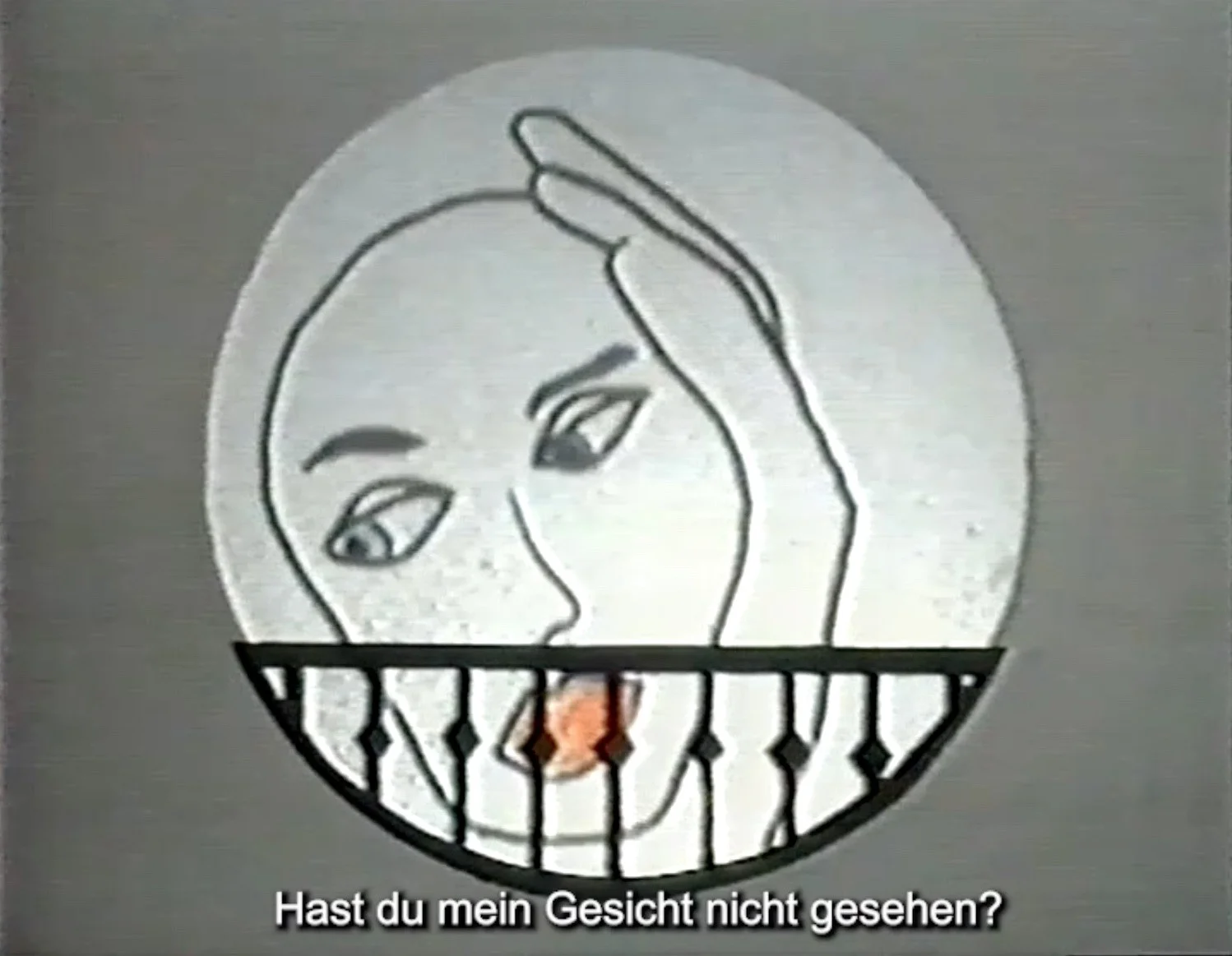
Linda Bilda’s video work Jungfer, Matrose und Student is based on the 1928 play of the same name by Federico García Lorca and is also the documentation of her diploma project in stage and film design, completed at the University of Applied Arts Vienna in 1989. The artist developed a complex, multimedia stage design for Lorca’s play.[1] The play, which centers on the ambivalent fate of a maiden and her struggle for self-determination, is interpreted by Linda Bilda through live actors as well as projected film footage and animated sequences.[2]
The stage design is laid out as a closed circle with four opposing openings: three doors and an elevated window that imitates a balcony. The central character, the maiden, “around whom everything revolves,”[3] appears as a film projection behind the peephole-like balcony—“unapproachable yet cheeky, swaying in the safety of her elevated position.” [4] While the other performers share the lower stage space with the audience sitting on semi-circular benches (the audience, however, is not visible in the video work). Linda Bilda reflects the symmetry of the four characters (maiden, old woman, sailor, student) in the spatial structure through the four openings of the stage set and uses the medium of film to unite their lines of sight on the projection surface[5]: here, the gaze of the admirers (sailor and student) and the audience meets the maiden, and from here she looks back as well. Additionally, her thoughts and feelings are visualized here as an animation.
Through its formal and thematic qualities, the video work illustrates how Linda Bilda’s training in stage and film design influenced her later artistic practice. In addition to the collaborative effort such a project demands, her body of work is characterized by referencing or quoting works of other artists and theorists, and by a critical yet humorous engagement with feminist, political, and socio-economic issues. This is evident in her choice of a play by Lorca—a politically persecuted Spanish poet and playwright who was murdered by fascists in 1936—and in the play’s thematic focus on female self-determination.
A key element of Linda Bilda’s transdisciplinary work is that the main character, the maiden, never appears as a real person, but literally ‘figures’ as a projection surface. Her dual representation—as a filmed actress and an animated drawing—points to a central aspect of Linda Bilda’s later work. In her drawings, paintings, and particularly sculptural pieces, the exploration of the (anti-)heroine and her (projected) translation into space remains significant. The artist often works with light and shadow to make figures appear doubled or illuminated, thereby reflecting their status as both identification figure and projection surface. Also characteristic is the ambiguous status of the video work itself. The three-part film does not merely document the play but contains media- and self-reflexive elements: it begins with footage of a lit stage model and ends by filming stage elements, including a monitor on which the camera recordings are played back live and in an endless mirror loop—finally, the artist herself appears on stage.
The video work was digitized in 2024 as part of the estate cataloguing process, together with analog photographs of the play. Additionally, related sketches, scripts, and drawings were archived. Based on these archival materials, subtitles could be added to the recording.
Curated by Lucie Pia
[1]: The play La doncella, el marinero y el estudiante, written between 1925 and 1928, is considered – alongside texts such as El paseo de Buster Keaton and Quimera – an example of Lorca’s experimental short plays. These avant-garde miniatures explore themes such as identity, freedom, and the search for love within a radically innovative theatrical aesthetic.
[2]: Information from a conversation with Stephan Schaja (July 1, 2025): The technical execution was extremely complex and required a large team of assistants. The entire piece was meticulously planned: the playback of different video sequences was controlled by a modified motor from an old washing machine, allowing the entire technical operation to run automatically, and requiring actors to hit their cues precisely. Moreover, due to the limitations of film projectors at the time, it was not possible to project from such a close distance onto the peephole, so the projections had to be intricately mirrored around corners.
[3]: From the script: Linda Bilda, Jungfer, Matrose und Student, 1989.
[4]: Ibid.
[5]: Ibid.
Images:
[1-3]: Video still: Linda Bilda, Jungfer, Matrose und Student, 1989. Courtesy Linda Bilda Estate.
[4-8]: Photographic documentation of the play: Jungfer, Matrose und Student, 1989. Photo: unknown. Courtesy Linda Bilda Estate.
[9-10]: Sketches: Linda Bilda, not dated. Courtesy Linda Bilda Estate.
In collaboration with basis wien – Documentation Center for Contemporary Art, Vienna.