Archive Newsletter No. 17
December 2025
Following Christian Fuhrmeister’s Archive Newsletter The Kunstverein München during the Nazi Era. What to Ask? How to Research?, Leona Koldehoff turns her attention to the period around 1950. The term “around” is used here as a precise preposition. As a method of approximation, it enables engagement with a historically specific yet unstable temporal configuration. “Around 1950” here refers to a period shaped by the aftermath of the World War II, institutional restructuring, and the contingencies of artistic and social networks across shifts in political systems. And it is within this indeterminate temporal configuration that Leona Koldehoff reconstructs the institutional framework and exhibition program of the Kunstverein München, tracing the complex interchange between actors, spaces, and artistic positions.
Art and Continuities at Kunstverein München around 1950
by Leona Koldehoff
There is a gap in Kunstverein München’s archives for the period from 1920 to 1970. Thus, records in other archives and libraries, such as the Munich City Archive (Stadtarchiv München), the Bavarian State Archives (Bayerisches Hauptstaatsarchiv), and the Monacensia, become important resources for reconstructing the art association’s activities in the period after 1945. Collecting and reviewing various archival materials is the starting point for answering questions about which people and events shaped the association’s activities after the end of World War II. How can archival materials such as correspondence, minutes, notes, and photographs be used to tell the history of the Kunstverein and its political, artistic, and civic networks after 1945?
1945–1947: Period of Personnel Reconfiguration at the Kunstverein
A thick folder in the Munich City Archive, held together by a narrow white ribbon, contains correspondence and invitations that the Kunstverein sent to the city's cultural office between 1931 and 1945.[1] The last sheet in the folder is a letter from Erwin Pixis to Karl Scharnagl dated July 2, 1945. Erwin Pixis was director of Kunstverein München from 1905 to 1945, and during the Nazi era he played a decisive role in bringing the association’s statutes and exhibition program into line with Nazi ideology.[2] In his letter to Karl Scharnagl, who was mayor of Munich until 1933 and again after 1945, Pixis offers the Kunstverein’s cooperation in rebuilding the city's cultural life and claims that the association had not been influenced by Nazi ideology. Pixis writes: “You can safely take a chance on us, because we have a ‘weiße Weste’ (clean record) and have come through the 1000 years completely unified.”[3] The motif of the “weiße Weste” is found in many texts where perpetrators deny their actions during the Nazi era.[4] Shortly before, in April 1945, all registered associations in the US occupation zone had been banned and had to reapply for a license from the US Army.[5]
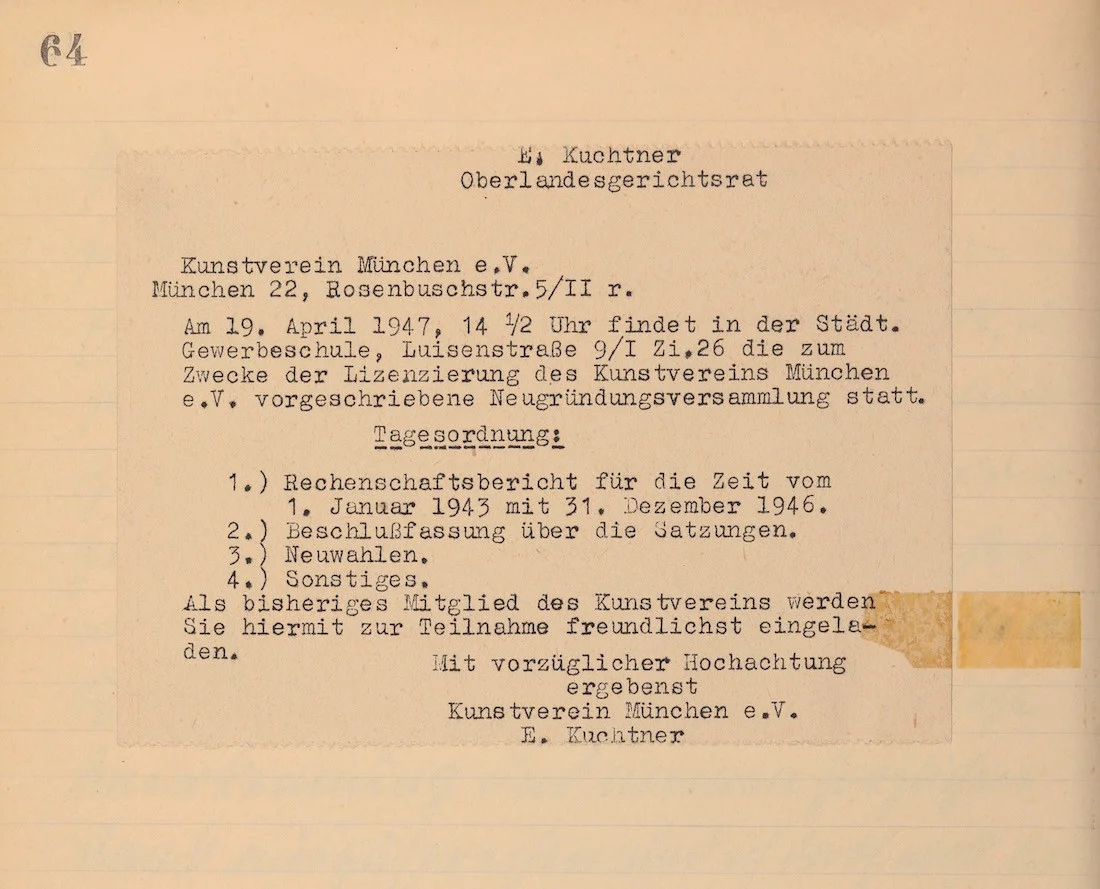
In April 1947, lawyer Eberhard Kuchtner invited members to the so-called re-founding general assembly of the art association.[6] The invitation, the minutes, and a list of signatures of the 56 people present are included in the so-called “Protokollbuch”, an association’s log book, which can be viewed in the Monacensia library.[7] If one flips back a few pages before these materials from 1947, one finds the minutes of the general meetings from 1943 and the association’s statutes from 1936, which contain an explicitly anti-Semitic passage.[8] The first page of the 1947 minutes refers to the licensing process, the accountability report for the years 1943 to 1946, and the decision on new statutes. Even though all three of these points would require explicit discussion of the Kunstverein’s past activities, its board, and members during the Nazi era, the minutes do not classify this period ideologically.[9] The second page of the minutes names the new members of the board and the so-called “Rat der Herren” (Council of Gentlemen). The board consisted of Eberhard Kuchtner as first chair, Anton Sappel as second chair, and Hans Doß as treasurer. The Council of Gentlemen was composed of the five so-called “Kunstmaler” (artistic painters) Karl Ewald Olszewski as chairman of the council, Hermann Böcker, Paul W. Ehrhardt, Ernst Haider, and Hans Müller-Schnuttenbach, as well as two other individuals.[10] Four of the five artists had demonstrably participated in the Große Deutsche Kunstausstellung (Great German Art Exhibition) at Haus der Kunst and the Münchner Kunstausstellung (Munich Art Exhibition) at the Maximilianeum during the Nazi era.[11] The Große Deutsche Kunstausstellung (1937–1944) was the most important art exhibition in the so-called Third Reich and stood under Adolf Hitler’s direct patronage.[12] The Münchener Kunstausstellung at the Maximilianeum was the most important art exhibition in Munich.[13] In addition, the painters from the Council of Gentlemen participated in other exhibitions during the Nazi era. During the period of personnel reconfiguration that started in 1947, the four artists who had participated in major exhibitions during the Nazi era were able to continue their careers after 1945 in prominent representative positions as members of the Council of Gentlemen. Further research is needed to reconstruct the professional biographies of the three board members Eberhard Kuchtner, Anton Sappel, and Hans Doß during this time period.[14] The questions of how the board and the Council of Gentlemen worked together, and who made which decisions also remain open.
1948–1952: Period of Spatial Reconfiguration: Exhibitions in the Städtische Galerie and Villa Zügel
Kunstverein München would not have its own exhibition space again until the mid-1950s, since the building at Galeriestraße 10 had been destroyed by a bombing raid in December 1944.[15] The first exhibition took place from December 19, 1947 to January 25, 1948 in the Städtische Galerie, today’s Städtische Galerie im Lenbachhaus und Kunstbau München.[16] From 1949 to 1952, the association organized exhibitions and events in the so-called Villa Zügel at Possartstraße 24 in Bogenhausen, which had been built in the 1920s for the painter Heinrich von Zügel, from 1895–1922 professor for painting at the Academy of Fine Arts (Akademie der Bildenden Künste) in Munich Heinrich von Zügel and his son Willy von Zügel also participated in the Große Deutsche Kunstausstellung and other exhibitions during the Nazi era. The exhibition program for 1949 has been preserved as a typescript.[18] The first exhibition was dedicated to Heinrich von Zügel. The listed group exhibitions Münchner Malerei von “Annodazumal” (Munich Painting from Back Then), Münchner Malerei von “HEUTE” (Munich Painting of Today), and Zeitgenössische Malerei (Contemporary Painting) presented artistic positions that were in line with the program of the Munich School—a conservative local art movement—or had been previously exhibited during the Nazi era.[19] In the spring of 1952, the Kunstverein ceased its exhibition activities at Villa Zügel.[20] The fact that the association was able to use the Villa Zügel as an exhibition venue in the postwar period can be seen as an indication that the Kunstverein’s connection in the bourgeois and artistic milieu continued uninterrupted by the change of political systems.
1953–1955: Opening of the New Building and First Exhibitions at Galeriestraße 4
On October 27, 1953 the Kunstverein opened its new premises at Galeriestraße 4, which are still in use to this day. In the early years from 1954 to 1956, freelance photojournalist Felicitas Timpe continuously photographed the exhibition openings.[21] Her photographs allow one to get an impression of the exhibition displays and social settings. The following section focuses on the interpersonal encounters during the openings.
In June 1954, the Kunstverein hosted the federal conference and exhibition of GEDOK – Gemeinschaften der Künstlerinnen und Kunstförderer e.V. (Associations of Women Artists and Art Patrons).[22] Twenty years earlier, in 1934, a conference of the federal association and an exhibition of GEDOK had already taken place in the Kunstverein’s former premises.[23] The exhibition Grafik – Malerei – Zeichnung (Prints – Paintings – Drawings, 1954) featured works by artists from various local GEDOK groups. A list accompanying the exhibition brochure lists the names of 121 artists.[24] Among others, the artists from Munich included the well-known painters Maria Caspar-Filser and Henny Protzen-Kundmüller, whose biographies had been influenced by National Socialism in very different ways, as Anke Gröner and Karin Althaus detail in the publication Kunst und Leben 1918 bis 1955.[25]
The photographs of the exhibition opening show the many artists in attendance. Of the key guests sitting in the front row during the opening, only Walther von Miller, then Munich’s Deputy Mayor and Officer of Cultural Affairs, has been identified so far. Another photograph shows Ernst Buchner smiling at photographer Felicitas Timpe as she takes the picture. During the Nazi era, Ernst Buchner was Director General of the Bavarian State Painting Collections (Bayerische Staatsgemäldesammlungen) and supported the implementation of Nazi cultural policy in this capacity. None of the artists present in the collection of photographs have been identified yet. Looking at the artists in the photographs raises questions about what kind of atmosphere they were meeting in. What were they talking about? What were their relationships with each other like at that time? Which private and professional experiences during the Nazi era connected them? And who doesn’t appear in the photographs? Did they talk about the artists who were members of GEDOK until 1933 but were murdered during the Nazi era? Who was missing?
On July 15, 1955, Olaf Gulbransson’s solo exhibition opened and ran until August 28, 1955.[29] The occasion was Gulbransson being awarded the City of Munich's Art Prize for Painting and Graphic Arts.[30] Gulbransson had worked as a cartoonist for the satirical magazine Simplicissimus since 1902. Since 1923 he had worked at the School of Arts and Crafts (Kunstgewerbeschule) in Munich, from 1929 to 1938 he was professor for painting and graphics at the Academy of Fine Arts and he continued teaching despite his retirement until 1943.[31] During the Nazi era, Gulbransson had participated in the Große Deutsche Kunstausstellung and other exhibitions. A photograph by Felicitas Timpe shows a conversation during the exhibition opening on 15 July. One sees Eberhard Kuchtner, the first chair of the Kunstverein München, speaking with Josef Oberberger, Franziska Bilek, Lothar Kuppelmayr, and Olaf Gulbransson. The artist Josef Oberberger was a student of Gulbransson and worked at the School of Arts and Crafts from 1939 and as professor for painting and glass art from 1946 to 1974 at the Academy of Fine Arts.[33] The illustrator and cartoonist Franziska Bilek was also a student of Gulbransson and worked with him at Simplicissimus from 1936 to 1944.[34] The journalist and editor Lothar Kuppelmayr was Bilek's partner. The mood in the photograph appears relaxed, friendly, and approachable.
Conclusion
Based on archival materials, this newsletter has described the personal, spatial, and artistic constellations that shaped the Kunstverein’s postwar activities. By looking at the network of members of the executive committee and the Council of Gentlemen since 1947, as well as the Villa Zügel as an exhibition venue from 1949 to 1952, one can identify clear connections between the Kunstverein and certain individuals, exhibitions, and spaces that were part of the artistic network in Munich during the Nazi era. The fact that the Kunstverein was able to use the Villa Zügel as an exhibition venue for several years is emblematic of the way personal and spatial interconnections with the bourgeois milieu continued uninterrupted across the change of political systems. The GEDOK federal conference and exhibition in 1954 and the Olaf Gulbransson exhibition in 1955 can be seen as further examples of Nazi continuities, both internally and in exchanges with other associations.[35] A closer analysis of Felicitas Timpe’s photographs of the exhibition openings from 1954 to 1956 and the identification of individuals would provide further insight into the social constellations and exhibited works.[36]
Given other research on the Kunstverein’s postwar history—such as Adrian Djukić’s Archive Newsletter The Concept of Class at Kunstverein München Part 4: From Art as a Weapon to the Saxophone as a Weapon against Art – Early 70s and 90s”—it becomes clear just how radical the institutional change in 1970 was. Around 1970, there was a shift from a reactionary to a progressive exhibition and event program.[37] The personnel and political developments that led to this change from the mid-1950s to the end of the 1960s require further archival research and conversations with contemporary witnesses.
What impact can this historical research have beyond the collection and interpretation of facts? One effect and a central concern of this text is to raise awareness of the diverse connections between personnel, artistic, and political contexts in art institutions—both in historical research and in the present. Here, it is also important to keep in mind the question of how public and private funding influence the work and orientation of institutions like Kunstvereine and museums, as well as research into their history. At present, critical engagement with the Nazi era and its impact on society is increasingly being called into question by right-wing extremist and right-wing populist actors and parties.[38] It is thus all the more important, both now and in the future, to network and exchange ideas in order to work together for a society based on democratic values and a critical examination of Germany's history.
Leona Koldehoff is a researcher in the arts and information science as well as a writer. Since 2025, she has managed the archive of the Kunstverein München. Her current research focuses on the history of the institution and its exhibition program in connection with contemporary history.
Copy Editing: Line Ebert
Proof Reading: Senta Gallant
Translation: Stanton Taylor (Good & Cheap Art Translators)
Many thanks to Maurin Dietrich, Adrian Djukić, Christian Fuhrmeister, Katrin Schumacher and Beo Tomek for the conversations as well as Angelika Betz and Dr. Cornelia Jahn (Image Archive of the Bavarian State Library) for the information on Felicitas Timpe's estate and providing the photographs.
Footnotes
[1] Letter from Erwin Pixis to Karl Scharnagl, July 2, 1947, Munich City Archive (Stadtarchiv München), reference code: DE-1992-KULA-0112-2.
[2] For the history of the Kunstverein München before, during, and after the Nazi regime, see Adrian Djukić, “Kunstverein München e.V.,” in Karin Althaus et al., eds., Kunst und Leben 1918 bis 1955, exh. cat., Städtische Galerie im Lenbachhaus und Kunstbau München, October 15, 2022 – April 16, 2023, Munich 2022, pp. 286–287; Christian Fuhrmeister, “The Kunstverein München During the Nazi Era. What to Ask? How to Do Research?,“ in Maurin Dietrich / Gloria Hasnay, eds., FOR NOW. 200 Years Kunstverein München, Munich / Berlin 2023, pp. 113–120.
[3] Letter from Pixis to Scharnagl (see note 1).
[4] On the cultural policy in Munich after 1945, see Marita Krauss, Nachkriegskultur in München. Münchner Städtische Kulturpolitik 1945–1954, Munich 1985; Beatrice Wichmann, Kultur verwalten – Demokratie gestalten. Kommunale Kulturpolitik und -verwaltung in München von 1956 bis 1978, unpublished dissertation, Munich 2023.
[5] Wolfgang Benz, “Demokratisierung durch Entnazifizierung und Erziehung,“ in Federal Agency for Civic Education (Bundezentrale für politische Bildung/bpb), published April 11, 2005, https://www.bpb.de/themen/nationalsozialismus-zweiter-weltkrieg/dossier-nationalsozialismus/39605/demokratisierung-durch-entnazifizierung-und-erziehung/ (accessed November 17, 2025).
[6] Erwin Pixis died in 1946. Cf. Fuhrmeister 2023 (see note 2), p. 115.
[7] The so-called “Protokollbuch” contains minutes taken at the assemblies held by the Kunstverein München e.V. between 1921 to 1954. See “Protokollbuch Kunstverein München e.V.,” Monacensia Library (Monacensia-Bibliothek), reference code C/C/6, Munich.
[8] In the association’s statutes from 1936, it states in § 8 “Membership” under section d, that “non-Aryans cannot be members of the association.” [Translated from the German original by the author.] In “Protokollbuch Kunstverein München e.V.” (see note 7).
[9] Minutes, General Assembly, April 19, 1947, in “Protokollbuch Kunstverein München e.V.” (see note 7). Why Eberhard Kuchtner took it upon himself to initiate the first assembly after World War II, coordinate the licensing process, and serve as first chairman from 1947 to 1956, has not yet been clarified. In a speech Kuchtner gave at a general assembly in 1954, he described himself as a “court-appointed guardian”. [Translated from the German original by author.] The typescript of the speech is part of the estate of Edeltraud Kuchtner, Eberhard Kuchtner’s sister. See “Rede Eberhard Kuchtner,” General Assembly, March 1954, Hanns Seidel Foundation Archive for Christian Social Politics (Hanns-Seidel Stiftung Archiv für Christlich-Soziale Politik), reference code: NL Kuchtner Edeltraud: Abgabe_45, Munich. Many thanks to Stefan Obermeier for providing the archival materials.
[10] According to the minutes, the two further members of the so-called “Rat der Herren” [Council of Gentlemen] were Senior Building Officer Adolf Fraaß and Baron Curt von und zu Egloffstein (see note 7).
[11] Which artists were participating in exhibitions during the Nazi era is readily determined by going through the index of names in the publication Kunst des frühen 20. Jahrhunderts. Teil 1 Ausstellungen deutscher Gegenwartskunst in der NS-Zeit (2000), edited by Martin Papenbrock and Gabriele Saure. Many thanks to Christian Fuhrmeister for pointing out this publication.
[12] It is possible to search on the GDK Research platform for information on the participating artists, the buyers, and the prices for which the works were sold. Karl Ewald Olszewski, chairman of the so-called “Rat der Herren,” participated in the annual Große Deutsche Kunstausstellung [Great German Art Exhibition] from 1938 to 1944 and sold his paintings to Joseph Goebbels, among others. See GDK Research, https://www.gdk-research.de/de/obj19364367.html (accessed November 27, 2025).
[13] Melanie Wittchow, “Münchner Kunstausstellungen im Maximilianeum 1938 bis 1943”, in Althaus et al. 2022 (see note 2), pp. 334–337.
[14] The Eberhard Kuchtner papers in the estate of Edeltraud Kuchtner contains numerous personal documents that would enable a reconstruction of Kuchtner's biography during the Nazi era (see note 9). The German Art Archive (Deutsches Kunstarchiv) contains a collection of documents relating to negotiations between the Arnold / Gutbier Gallery and Erwin Pixis and Anton Sappel as representatives of the Kunstverein München dating from 1935 to 1940. The collection was not examined or evaluated for this text. See Deutsches Kunstarchiv, reference code: Arnold Gutbier, Galerie, I,B-604, Nuremberg.
[15] Letter of confirmation from the regional director of the so-called “Reichskulturkammer” [Reich Chamber of Culture] to the regional cultural administrator of Munich-Upper Bavaria, January 21, 1945, Bavarian State Archives (Bayerisches Hauptstaatsarchiv), reference code: MK 51575, Munich.
[16] Stephanie Weber, “Ausstellungen in der Städtischen Galerie im Lenbachhaus 1929 bis 1955,” in Althaus et al. 2022 (see note 2), p. 48.
[17] Birgit Jooss / Sabine Brantl, “Rektoren, Professoren, Ehrensenatoren und Ehrenmitglieder der Akademie der Bildenden Künste München 1808–2008”, in Nicklaus Gerhart, Walter Grasskamp, Florian Matzner, eds., 200 Jahre Akademie der Bildenden Künste München, Munich 2008, p. 558; Cf. GDK Research, www.gdk-research.de (accessed November 17, 2025).
[18] Overview Exhibitions Kunstverein München e.V. 1949, Munich City Archive, reference code DE-1992-KULA-1416.
[19] Djukić 2022 (see note 2), p. 287.
[20] In an article in the Münchner Merkur, Richard Braungart reported on the Kunstverein München moving out of its location at Villa Zügel. He thanked Anton Sappel, the association's second chairman, and his wife, the painter Martha Sappel, for their contribution. Martha Sappel was a member of the Kunstverein, but—according to current research—she never held an official position. She exhibited at the Große Deutsche Kunstausstellung in 1943 and 1944. See Richard Braungart, “Der Kunstverein zieht um”, in Münchner Merkur, May 1952.
[21] Felicitas Timpe studied art history, literature, and theater studies in Munich from 1940 to 1942 and completed an apprenticeship as a photographer in Berlin after 1945. From 1950 to 2002, she worked as a freelance photojournalist in Munich. Her estate is part of the Image Archive of the State Library (Bildarchiv der Bayerischen Staatsbibliothek), Munich. See https://www.bsb-muenchen.de/sammlungen/bilder/fotoarchive/fotoarchiv-felicitas-timpe/ (accessed October 14, 2025).
[22] The conference took place from June 11 to June 14, 1954 and the exhibition from June 11 to June 24, 1954 at Kunstverein München. See Elke Lauterbach-Philip, Die GEDOK (Gemeinschaft der Künstlerinnen und Kunstförderer e. V.) – ihre Geschichte unter der besonderen Berücksichtigung der Bildenden und Angewandten Kunst, Munich 2003, p. 163ff.
[23] The conference in 1934 took place after Ida Dehmel, a Jewish woman and founder of GEDOK, was forced by the National Socialists in 1933 to resign as chairwoman of GEDOK Hamburg and the federal association. Ida Dehmel committed suicide in 1942. After the end of World War II, her niece Marianne Gaertner became chairwoman of the federal GEDOK. In 1954, she gave the welcoming speech at the federal conference and exhibition opening, followed by a lecture by government director Dr. Irma Heinrich and an opening speech by Walther von Miller, the Munich’s Second Mayor and Officer of Cultural Affairs. See Lauterbach-Philipp 2003 (see note 22), pp. 65–68, p. 78; For press coverage of the federal conference and exhibition, see Munich City Archive, reference code: DE-1992-ZA-05142. Many thanks to Philipp Zölls for providing the archival materials!
[24] GEDOK, ed., Bundesausstellung der GEDOK 1954. Grafik – Malerei – Plastik, exh. cat., Kunstverein München, June 11 – June 24, 1954, Munich 1954.
[25] Katrin Althaus, “Maria Caspar-Filser,” in Althaus et al. 2022 (see note 2), pp. 80–83; Anke Gröber, “Henny Protzen-Kundmüller,” in Althaus et al. 2022 (see note 2), pp. 208–211.
[26] In her dissertation, Theresa Sepp examines the collaboration between Ernst Buchner and Kunstverein München during and after the Nazi era. See Theresa Sepp, Künstlerisch, wissenschaftlich, unpolitisch? Ernst Buchner (1892–1962), Kunsthistoriker und Museumsleiter vor und nach 1945, Munich 2020, p. 132ff., p. 342, p. 348.
[27] The facts that the appearances of Walther von Miller and Ernst Buchner are known today and that other portraits exist so that these materials can be compared and confirmed, are testaments to von Miller and Buchner’s public and historic visibility. The fact that none of the artists present could be identified is symbolic of the lack of knowledge about artists during this period.
[28] Elke Lauterbach-Philip, “Das Schicksal der jüdischen Mitglieder und die Frage der Solidarisierung von GEDOK-Mitgliedern,” in Lauterbach-Philip 2005 (see note 22), pp. 92–96.
[29] Invitation card and catalog accompanying the solo exhibition by Olaf Gulbransson, Munich City Archive, reference code: DE-1992-ZS-0231-2.
[30] Cf. Olaf Gulbransson Museum, https://www.olaf-gulbransson-museum.de/olafgulbransson (accessed November 17, 2025).
[31] Jooss / Brantl 2008 (see note 17), p. 559; In a lexicon entry, Paul Hoser states: “Gulbransson, Arnold, and others […] crowded the Jews Schoenberner and Heine out of the newspaper”. [Translated from German original by the author.] Paul Hoser, “Simplicissimus (Zeitschrift),” in NS-Dokumentationszentrum München, ed., nsdoku.lexiko, published January 16, 2025. See https://www.nsdoku.de/lexikon/artikel/simplicissimus-zeitschrift-781 (accessed November 17, 2025); In 1954, Franziska Bilek held a solo exhibition at the Kunstverein München. See Kunstverein Munich, https://www.kunstverein-muenchen.de/de/programm/ausstellungen/rueckblick/1954/franziska-bilek (accessed November 17, 2025).
[32] Cf. GDK Research, www.gdk-research.de; Papenbrock/Saure 2000 (see note 11).
[33] Jooss / Brantl 2008 (see note 17), p. 560.
[34] Cf. Literature Portal Bavaria (Literaturportal Bayern), https://www.literaturportal-bayern.de/autorenlexikon?task=lpbauthor.default&pnd=118663178 (accessed November 27, 2025).
[35] The fact that GEDOK held a national conference and exhibition at the Kunstverein 1934 as well as 1954 suggests that researching the relationship between the instititutions, i.e. associations, could shed light on the ruptures and the continuities in the field of art after 1945. What was the relationship between the members of the two institutions? Who was a member of which institution in which period of time? Which personal and artistic overlaps could be traced?
[36] On the relationship between photography and community in the first half of the 20th century in Germany, see Linda Conze, Die Fotografie und das Fest. Zur medialen Herstellung von Gemeinschaft zwischen Weimarer Republik und Nationalsozialismus, Goettingen 2025.
[37] A prime example of this is the exhibition Verändert die Welt! Poesie muss von allen gemacht werden (1970). In the contribution by students of the Academy of Fine Arts Munich, they examined the professional biographies of professors during the Nazi era and their (continued) employment after 1945. Whether and, if so, how the personnel continuities with the Nazi era at the Kunstverein were discussed at this time requires further archival research and conversations with contemporary witnesses.
[38] The booklet Schnee von gestern? Zum Umgang mit dem Kulturkampf von rechts in Gedenkstätten und Museen states: “That right-wing extremists consider remembrance politics a key battleground is not a new phenomenon. Since the 1950s, in particular public remembrance of National Socialism, alongside the memorial sites of the Nazi era, have repeatedly been under attack from the right. However, at least since the turn of the millennium, remembrance of NS crimes has become a given in German politics and public life. This is seen reflected in an institutionalized, professionalized, and state-funded landscape of memorial sites. In addition, numerous efforts have been made in recent years to come to terms with Germany's colonial past. [...] The fact that the critical engagement with National Socialist crimes is part of the Federal Republic's self-understanding is a major obstacle and nuisance for the extreme far-right and right-wing populist ambitions for national greatness. That is why one of the central concerns of the far-right milieu is to overturn this self-understanding.” [Translated from German original by author.] See Verein für Demokratische Kultur in Berlin (VDK) e.V. and Mobile Beratung gegen Rechtsextremismus Berlin (MBR), ed., Nur Schnee von gestern? Zum Umgang mit dem Kulturkampf von rechts in Gedenkstätten und Museen, Berlin 2024, pp. 3–5.; Cf. Mobile Counseling Against Right-Wing Extremism Berlin (Mobile Beratung Gegen Rechtsextremismus Berlin), https://www.mbr-berlin.de/publikationen/nur-schnee-von-gestern-zum-umgang-mit-dem-kulturkampf-von-rechts-in-gedenkstaetten-und-museen-2020/ (accessed December 10, 2025).
Fig.:
[1] Invitation to the Kunstverein München‘s General Assembly (1947). © Monacensia-Bibliothek.
[2] Note on the exhibition by Kunstverein München at the Städtischen Galerie (1948). © Kunstverein München e.V.
[3] Cover of the exhibition catalogue Grafik - Malerei – Plastik, June 11–June 25, 1954, Kunstverein München.
[4] Invitation to the exhibition by Kunstverein München e.V. (1947). © Kunstverein München e.V.
[5] Overview of the exhibition program by Kunstverein München (1949). © Kunstverein München e.V.
[6] Invitation to the exhibition Heinrich v. Zügel (1949). © Kunstverein München e.V.